Managing complexity
“It is not the task to simplify or to reduce the complexity of real lifeworlds of customers to a maximum. Instead, it is crucial to make them manageable and guiding for very important corporate decisions.”
Dr. Michael Schindl
The Concept Map
Concept Maps have been developed by Professor Joseph Novak at the Cornell University/U.S.A. in the 60s. They illustrate knowledge in the form of a network with closely connected concepts or issues.
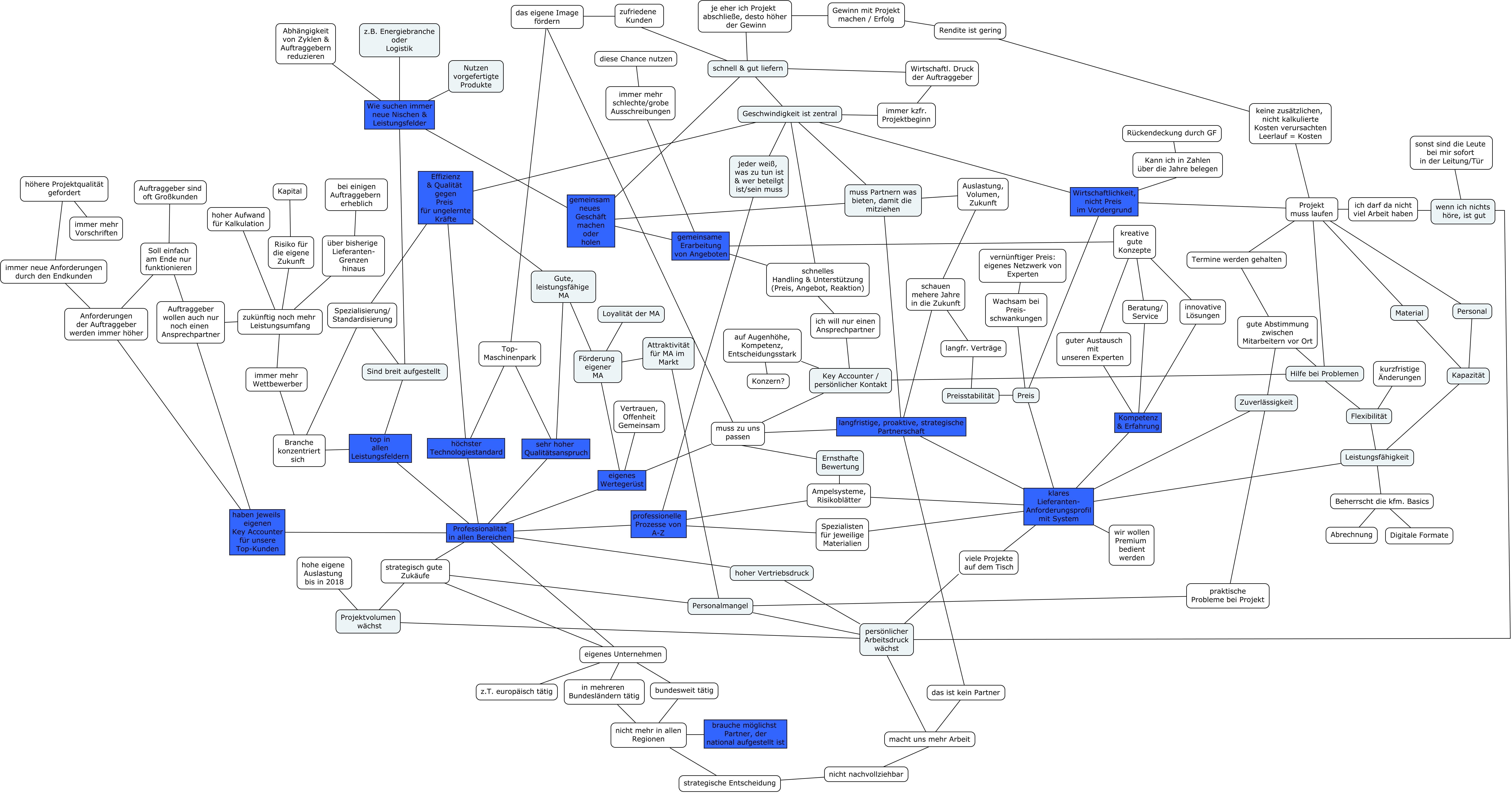
Concept Maps are perfectly suited for visualizing complex real facts. Concept Maps support the capture and understanding of comprehensive and detailed knowledge in a very fast way. Thus, they are a wellspring for new ideas.
Concept Maps are contrary to Mind Maps as they are not made up of hierarchical content. Instead, they show a network that is composed of concepts, issues and ideas including their relationships to each other. By this, all aspects of an issue can be clearly represented and can be understood at first glance.
The “lifeworld” of customers is key
With STORYlistening® a Concept Map is used in order to understand the lifeworlds of customers at a glance. People make decisions only in the context they see relevant issues for this decision and themselves. Knowing these decision drivers and their contextual setting within personal, i.e., values, constraints, meanings or attitudes means to be able to draw the right strategic conclusions. The Concept Map elicits exactly these contexts.